SIDSynth captures the spirit of the SID — pulse, saw, triangle, noise, sync, ring, and a filter with a personality — then gives those ideas modern polyphony, MIDI expression, and a patch system that can travel.
Why it is not an emulation
A cycle-accurate emulator tries to reproduce one chip, including its timing quirks and board-to-board drift. That is the right tool for restoration. SIDSynth is the other tool: waveform mathematics and DSP inspired by the same behaviors, free of the original voice count and control limits.
SIDSynth
Hardware emulation
Best at
New music, performance, and sound design
Matching a particular SID board
Voices
Modern poly, mono, and legato, with three oscillator layers
Bound to the original architecture
Consistency
The same sound on every machine
Chip and host variation is part of the charm
Trade-off
It will not clone every analog accident
Less room to extend the instrument
Three oscillators, one musical rack
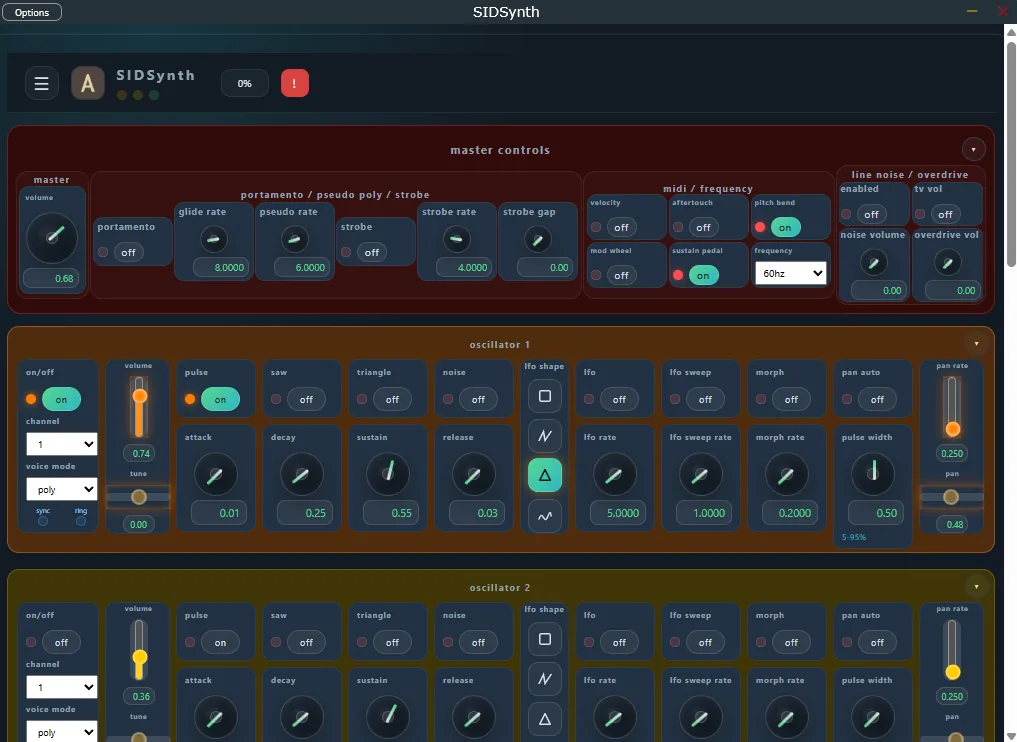
Each oscillator has pulse, saw, triangle, and noise, its own envelope, tune, pan, and LFO. Pulse width can move on its own sine, separate from the pitch LFO. Voice mode is poly, mono, or legato, and portamento rate is a performance control rather than a hidden SID trick.
Hard sync and ring modulation stay available, but they are choices. The cookbook's first warning is the right one: do not switch both on just because they sit near each other.
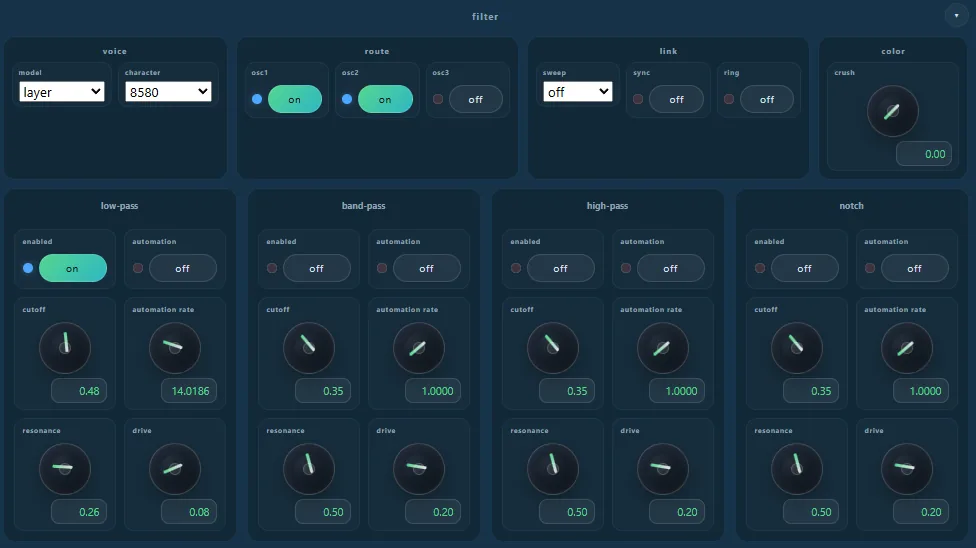
Oscillator 1, with waveform, envelope, LFO, and pan in one row.Filter model, routing, and four simultaneous filter paths.
A filter with two characters
Choose a Layer or SID voice model, then a 6581 or 8580 character. Low-pass, band-pass, high-pass, and notch can be enabled independently, each with cutoff, resonance, drive, and automation. Oscillators route into the filter instead of being trapped behind one global switch.
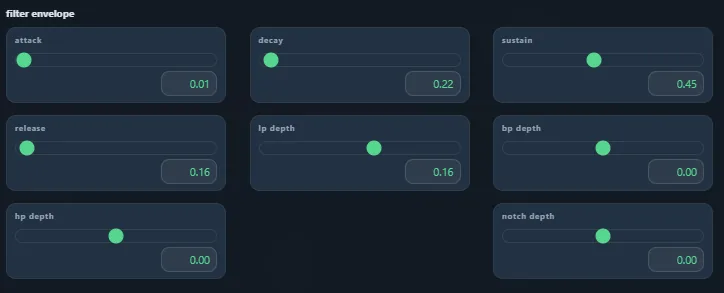
The shared filter envelope opens the cutoff on the newest note and settles back. That is the quack in a bass, or the slow bloom in a pad, without a second synthesizer.
Filter envelope
Attack, decay, sustain, and release, with separate depth for each filter path. Positive depth brightens as the envelope rises.
Held-note arpeggiator
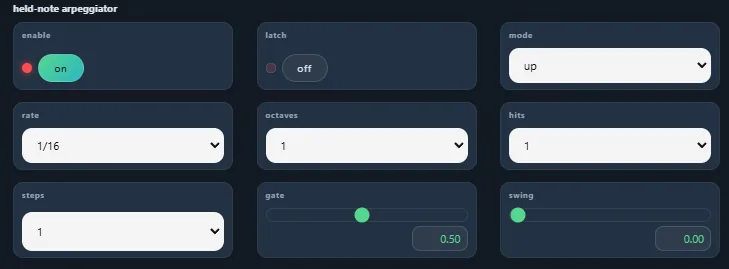
Latch a chord and let it climb, fall, or walk. Rate follows the host tempo, with gate, swing, octaves, and step length.
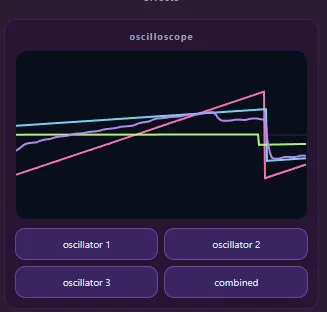
Oscilloscope
Watch oscillator 1, 2, 3, or the combined voice while you edit. It is a tuning tool, not a decoration.
Expression that stays mapped
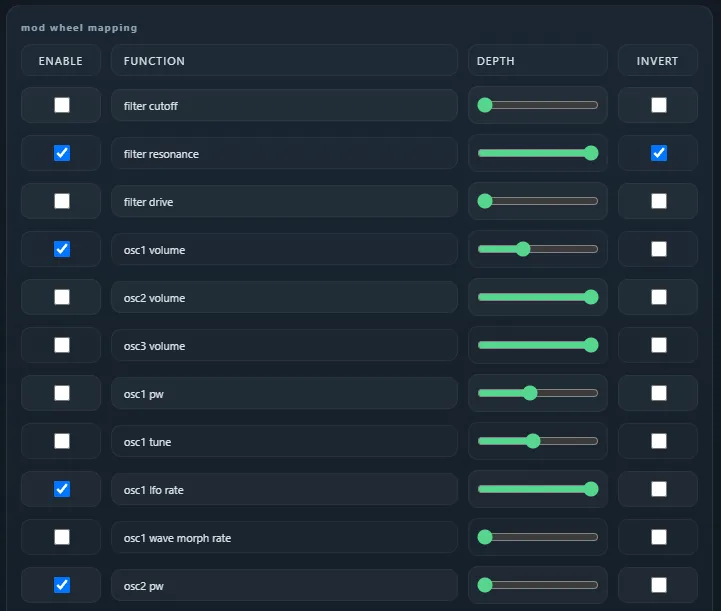
Velocity, aftertouch, pitch bend, sustain, and the mod wheel are switches, not assumptions. The mod-wheel map assigns depth and invert per destination: filter cutoff, resonance, drive, oscillator volume, pulse width, tune, and LFO rate.
Tempo sync copies an exact note-rate in hertz onto any tempo-sensitive control, including dotted and triplet values. Line noise can add 50 or 60 Hz hum, and speaker overdrive adds a small cabinet edge. Both ship off in banks built by the librarian.
Singles, multis, and banks
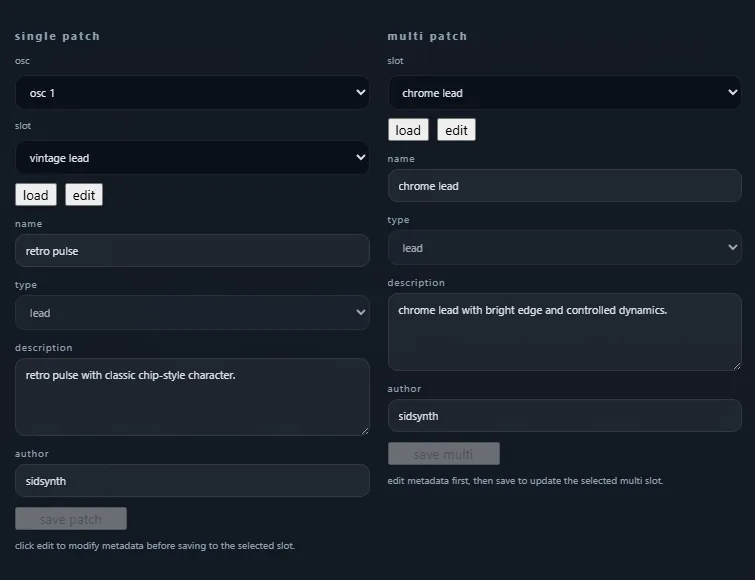
A single patch is one oscillator voice. A multi is a complete instrument: up to three oscillators, the filter, effects, and the performance map. Sixty-four singles and sixty-four multis fit in one .sidbank.
Registration unlocks bank load, bank save, and patch writing. Until then you can still audition the factory sounds and build a custom bank in the librarian, ready for the day the license arrives.
 sidsynth